What is TheStrat?

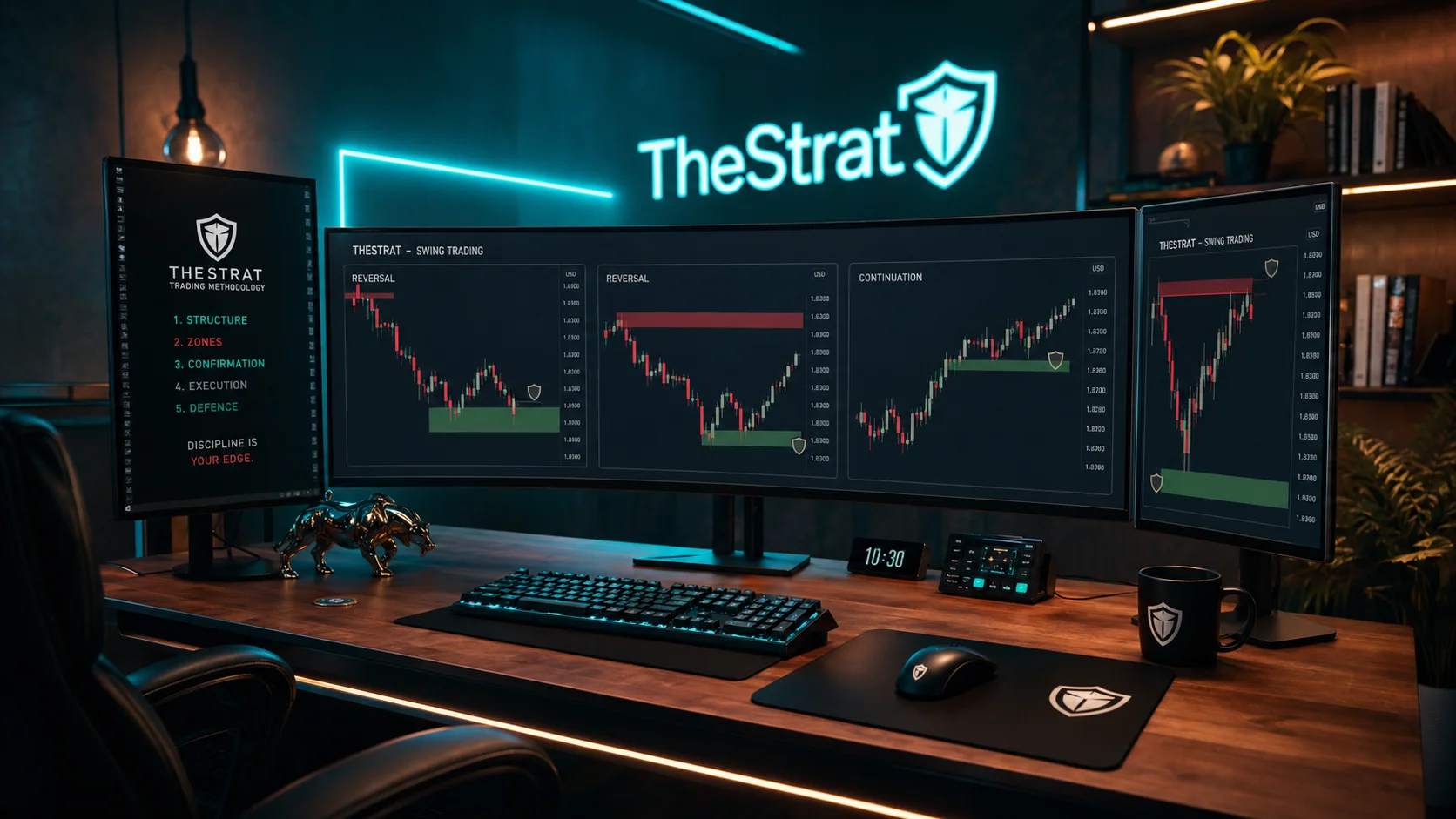
What is TheStrat?
Most traders do not fail because they lack information.
They fail because they do not have a clear way to read price.
They add indicators, draw extra lines, and keep checking for more confirmation, but the chart only gets noisier.
The result is hesitation, confusion, and missed trades.
TheStrat is a way to solve that problem.
It is a framework for reading price action directly, so you can make decisions based on what price is actually doing instead of what you think it might do next.
TheStrat is a framework for reading price action directly.
Why price matters?
Price is the only thing that actually moves the market.
Indicators follow price.
News explains price.
Neither of them replaces price.
If you want to understand the market properly, you have to start with price itself.
That means learning to recognise when price is contracting, expanding, or confirming a move.
What TheStrat is
At its core, TheStrat is a simple way to classify candles based on what they do relative to the prior bar.
It gives you a shared language for reading the chart without overcomplicating it.
The point is not prediction.
The point is to wait for confirmation and then act with a defined stop and a clear reason for the trade.
The point is not prediction. The point is confirmation.
The basic candle types
TheStrat boils price action down to a few simple scenarios.
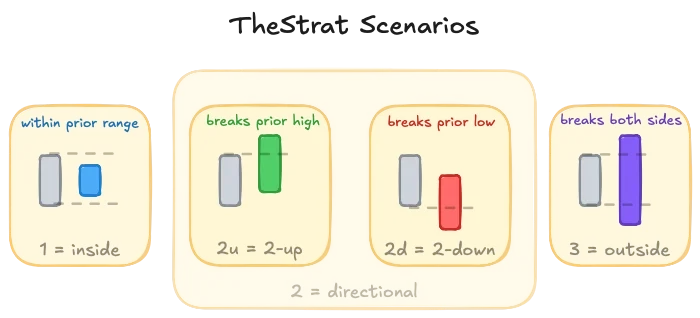
Inside bar
An inside bar stays within the range of the previous candle.
This usually means the market is pausing or compressing.
Price has not yet shown its hand.
Directional bar up
A directional bar up breaks above the previous candle’s high.
This shows upward expansion and tells you buyers are in control for that moment.
Directional bar down
A directional bar down breaks below the previous candle’s low.
This shows downward expansion and tells you sellers are in control for that moment.
Outside bar
An outside bar breaks both the high and the low of the previous candle.
This means the market has tested both sides of the range.
It often resets expectations and can lead to a stronger move once price resolves.
Confirmation over anticipation
One of the most important lessons in TheStrat is simple:
trade confirmation, not hope.
A setup is not enough on its own.
You want price to actually confirm the move before you commit.
That is what makes the framework useful.
It gives you a trigger, an invalidation, and a reason to stay out when the setup is not ready.
Structure matters
The same candle pattern can be good in one place and poor in another.
Location matters.
Context matters.
Structure matters.
A clean setup at a meaningful level is far more useful than a random candle pattern in the middle of nowhere.
That is why TheStrat is not just about the candle type.
It is about reading the candle in context.
FTFC and broadening formation
Two ideas make TheStrat stronger in practice.
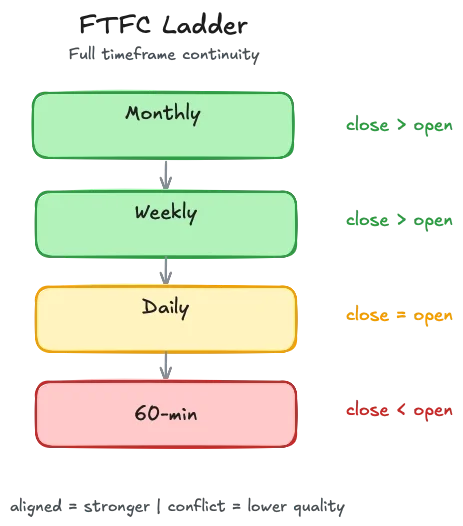
FTFC
FTFC means full timeframe continuity.
It asks whether the higher timeframes are aligned, so the move on your trading timeframe is backed by the bigger picture.
In simple terms:
- if the higher timeframes agree, your setup has more support
- if they conflict, the trade is weaker
- if they all point the same way, probability improves
When the higher timeframes agree, you are trading with the wind at your back
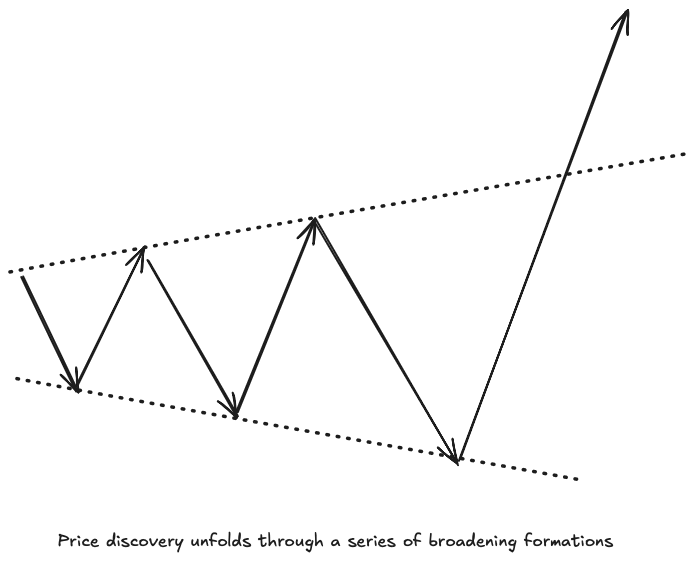
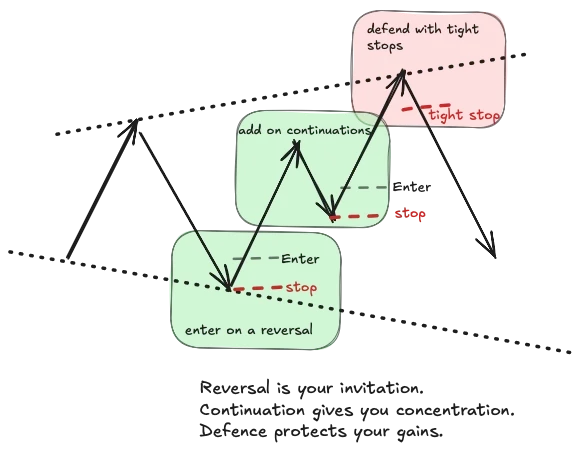
Broadening formation
A broadening formation is the market expanding and testing both sides of a range.
It matters because price often makes its real decisions at the edges, not in the middle.
That is where reversals happen.
That is where continuations prove themselves.
That is where the market tells you whether buyers or sellers have control.
Reversal, continuation, and defence
TheStrat is not just about spotting a pattern.
It is about knowing what kind of trade you are in.
You can use it three ways:
- enter on reversal when price turns from an important edge or failed move
- add on continuation when price confirms and keeps moving in the same direction
- defend with tight stops so a failed idea does not become a large loss
That is the discipline.
Reversal gives you the turn.
Continuation gives you concentration in a winning trade.
Defence keeps the damage small when you are wrong.
Reversal first. Continuation second. Defence always.
Why traders use it
TheStrat helps traders:
- read price more clearly
- avoid overanalysis
- define risk before entry
- wait for confirmation
- avoid chasing
- stay disciplined
- align with the higher timeframe
- understand when a move is happening at the edge of structure
It gives you a repeatable process.
That matters because trading is not about being clever.
It is about being consistent.
How to think about it in practice
If you are looking at a chart through TheStrat, ask:
- Is price inside the prior range or breaking out?
- Has the move confirmed?
- Where is the invalidation?
- Is the setup happening in the right place?
- Is the higher timeframe aligned?
- Is this a reversal, a continuation, or just movement?
SwingTheStrat Operating System
SwingTheStrat uses TheStrat as a practical swing-trading framework.
The aim is to find clean setups, wait for confirmation, manage risk properly, and avoid noise.
That means:
- market first
- sector second
- stock third
- setup fourth
- trigger(actionable signals) fifth
- risk sixth
- FTFC and structure always in view
Final thought
TheStrat is simple, but it is powerful.
It gives traders a systematic way to read price action without clutter, guesswork, or unnecessary noise.
If you remember one thing, remember this:
TheStrat is not about predicting price. It is about reading price and responding with discipline.
Where to go next?
This introduction is the starting point.
we will dive deeper into specialist topics so that TheStrat becomes even easier to use.
- SwingTheStrat Core Operating Principles
- Market Regime
- Reversal Playbook
- Gaps and Opening Dynamics
- Sector and Leadership
- Continuation Mechanics
- Risk Management
- Trading Psychology
Frequently Asked Questions
What timeframes should I use with TheStrat?
For day trading, use the daily, 60-minute, and 15-minute charts. For swing trading, start with the monthly, weekly, daily, and 60-minute charts. The main job is the same: make sure the higher timeframes are not fighting the setup you want to trade.
Can I trade against FTFC?
You can, but the trade is weaker. FTFC is there to keep you on the side of the bigger move. When the timeframes conflict, you are usually fighting the tape instead of trading with it.
What is the main edge of TheStrat?
The edge is not prediction. The edge is confirmation, structure, and discipline. TheStrat helps you wait for the move to prove itself before you risk money.
Why do broadening formations matter?
Because they show price discovery in motion. The market is expanding, testing both sides of the range, and telling you where real decisions are likely to happen.